
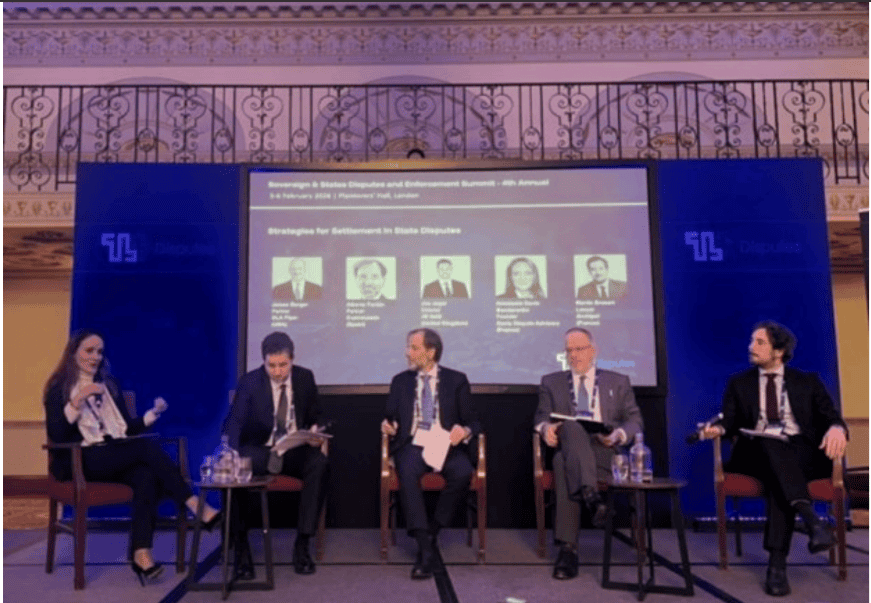
On 5 February 2026, Anastasia Davis Bondarenko joined James E. Berger, Joe Jegat, Martin
Brasart and Alberto Fortún to discuss what actually moves the needle in settlement discussions
with States. The premise was simple: settlement in sovereign disputes is rarely about
enforcement doctrine alone. It is about authority, incentives, timing, leverage, and design.
Across jurisdictions, States are developing different institutional architectures for dispute
prevention, coordination and settlement authority. Treaty frameworks also create procedural
space for early dispute resolution. But none of this replaces the need for a coherent strategy
that integrates law, intelligence, and strategy.
For award creditors and their advisers, the challenge is to move beyond a purely doctrinal
approach to enforcement and think holistically about how leverage is created—and how
settlement becomes possible.
Below are a few practical lessons from the discussion that apply in pre- and post-award
contexts.
- Classic negotiation tools don’t translate neatly to sovereigns
In commercial disputes, parties typically have a defined walk-away number and a clear internal authority to agree terms. With States, that “yes” often does not exist early on. Settlement authority is political, fragmented, and can shift over time. As a result, early settlement may be difficult to achieve—not because positions are entrenched, but because there is no authorized decision-maker who can approve a deal. - Identify the real counterparty: authority vs. consequences
Who can approve a settlement is often not the same actor who bears the consequences of non-settlement. Ministries, SOEs, treasuries, cabinets, or political advisers may each hold different pieces of the puzzle. In many cases, momentum only builds once pressure lands with the part of the State that both (i) feels the consequences and (ii) has the authority to approve terms. - Timing creates leverage
There is often a narrow window post-award (and pre-challenge or stay of enforcement) where prepared creditors can move quickly and create meaningful pressure. Parties who have completed stakeholder mapping, asset intelligence and enforcement strategy planning in advance are best placed to act decisively when timing permits. - Leverage is more than attachment
Attachments and interim measures remain important tools, but they rarely operate in isolation. Reputational and political considerations often combine to create the conditions for movement. The question is not only “what can be seized?” but “what creates sufficient pressure to bring the State to the table?” - “Cash isn’t always king.”
For very large claims, a single action will rarely generate enough leverage to settle the full amount at a level that satisfies the creditor. Settlements may involve assets, concessions, structured payments, or other forms of value. Creative deal design can make settlement politically palatable while preserving meaningful recovery.
Because public money and political accountability are involved, the structure of a settlement often matters as much as the headline number. Timing, sequencing, confidentiality, and non-monetary elements can provide decision-makers with a defensible narrative for why settlement was unavoidable and responsible.